About the Journal
Purposes
Our journal is dedicated to the dissemination of high-quality scientific and technical material that contributes to the knowledge and development of sustainable and resilient agricultural production systems. With more than 2,000 visits in the last six months, our Magazine has established itself as a reference space for the scientific and technical community interested in agricultural and life sciences.
Topics of Interest
- Veterinary and animal sciences
- Principles and practices of agroecology
- Agricultural production
- Agroindustrial transformation of agricultural products
- Technological innovations in agroecological production
- Sustainable management of natural resources in the agricultural sector
- Public policies and sustainable rural development
- Academic-research experiences that contribute to the generation of knowledge
and dissemination of science in the field of biological sciences, life and
health.
Each manuscript received will be subjected to a rigorous review process by the journal's editorial team, in the first instance by the ad hoc editors by thematic areas (agribusiness area, veterinary sciences area, animal sciences areas, among others), subsequently by the central editorial team, trying to contribute to the quality and relevance of the material submitted and subsequently published.
Originality and Ethics Criteria
- Manuscripts must be original works, not previously published or under consideration for publication in another journal.
- They must strictly follow the ethical principles in research, including approval by research ethics committees when applicable.
Submission Process
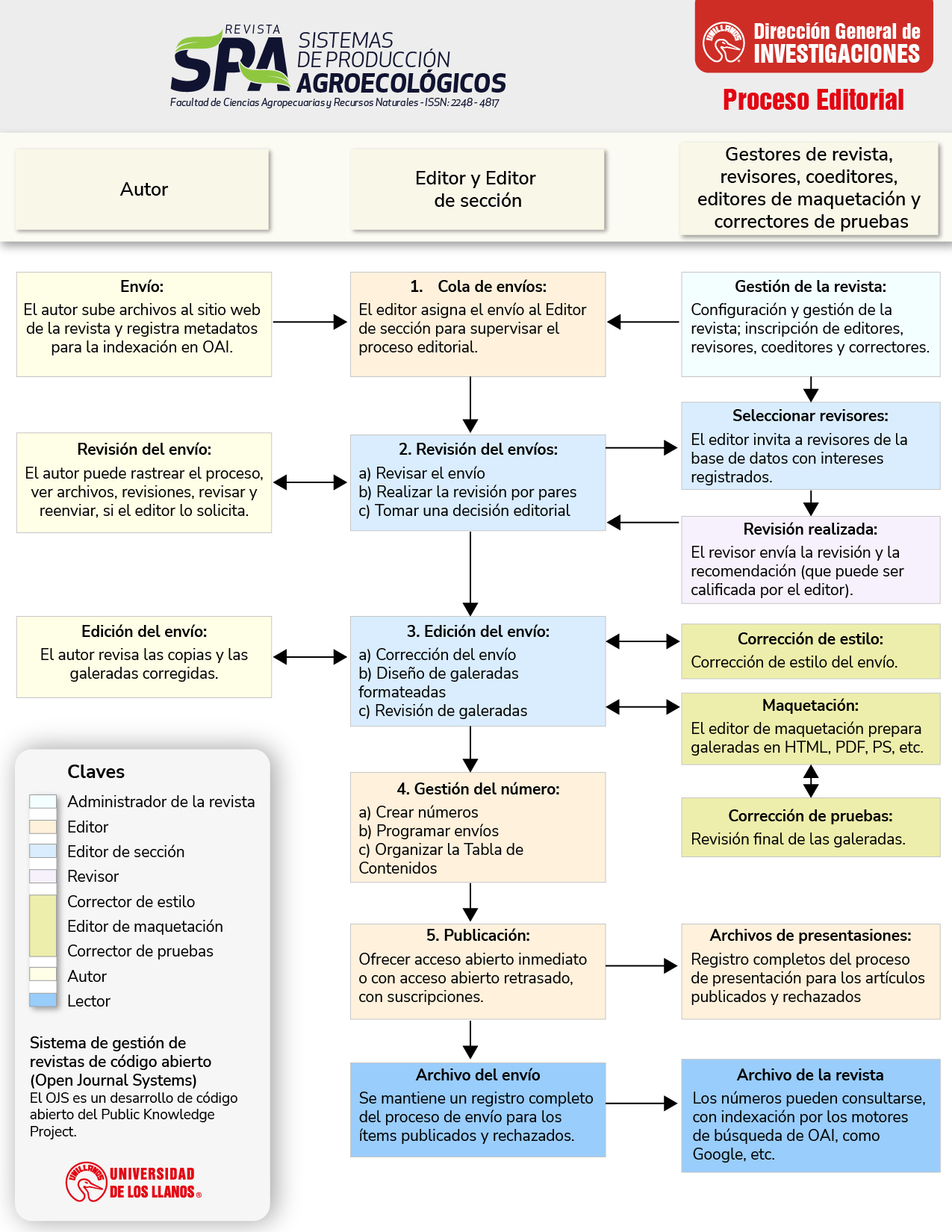
The editorial process of the Journal of Agroecological Production Systems follows a series of well-defined steps from the submission of the article to its publication, guaranteeing the quality and relevance of the published works.
Submission of the article
Authors interested in publishing must submit their manuscripts through the electronic platform of the journal. The manuscript must comply with the editorial standards established by the journal.
Preliminary review
Once the article is received, the editor-in-chief performs a preliminary review to verify that it meets the basic requirements of the journal, such as originality, format, and thematic relevance. If the article does not meet these criteria, it is returned to the author for corrections or rejected.
Internal committee assignment
If the manuscript passes the preliminary review, it is assigned to the internal editorial committee for peer review, composed of experts in agroecology and related areas. The committee is in charge of carrying out the technical and scientific evaluation of the article.
Evaluation by the internal committee
The members of the editorial committee carry out a detailed review of the article, evaluating aspects such as:
Relevance of the topic in the context of agroecology.
Originality of the research.
Methodological quality, accuracy of the results and scientific rigor.
Contribution to the field of agroecological production.
Clarity and coherence in writing.
This evaluation generally takes between 2 and 4 weeks, depending on the availability of the committee and the complexity of the topic.
Editorial decision
Based on the evaluation of the internal committee, the editor-in-chief makes a decision, which may be:
Acceptance of the article without changes.
Acceptance with minor corrections, requesting the author to make style adjustments or clarifications.
Major revision, where the author is required to make substantial changes to the content and methodology.
Rejection of the article if it does not meet quality standards.
The editor communicates the decision to the author and, if necessary, details the corrections required. The author has a certain period of time to make the adjustments and resubmit the article.
Final review
If the article has been accepted with corrections, the committee reviews the corrected version to verify that the requested changes have been made. In some cases, it may be necessary for the author to respond to additional comments.
Layout and proofreading
Once approved, the article goes through the layout process, where it is adjusted to the journal's publication format (typography, margins, tables, graphics). After this step, the author receives a galley proof for final review of typographical or formatting errors.
Publication
After proofreading, the article is included in the corresponding edition of the journal and is published in digital or printed format, as the case may be. Authors and editorial board members receive notice of official publication and the article is distributed through the journal's distribution channels.
Declaration of Copyright and Conflict of Interest
- Authors must declare any potential conflict of interest and assign copyright to the journal if their article is published.
Authors retain the rights of publication and authorship of the published article.
These guidelines aim to ensure that all submitted manuscripts meet the quality and ethical standards required for consideration and publication in the Journal of Agroecological Production Systems. We thank the authors for choosing our journal to disseminate their work and contribute to the advancement of agroecology and sustainability in the agricultural sector.
Open Access Policy
Each article published in the SPA Journal will be open access, which means that, once published, readers will be able to access the manuscripts without the need for a subscription or membership.
Thank you for choosing our magazine to disseminate your work and contribute to the advancement of agroecology and sustainability in the agricultural sector.
These guidelines aim to ensure that all submitted manuscripts meet the quality and ethical standards required for consideration and publication in the Journal of Agroecological Production Systems. We thank the authors for choosing our journal to disseminate their work and contribute to the advancement of agroecology and sustainability in the agricultural sector.
Shipping process
Contacts
Contact
Editorial team
Policies
Evaluation process