Submissions
Author Guidelines
Guidelines for Authors – Sistemas de Producción Agroecológicos Journal
Sistemas de Producción Agroecológicos Electronic Journal invites the scientific and technical community to contribute with their research and knowledge in the veterinary sciences field and the sustainable agricultural production systems.
It is important to note that this publication is published on a semi-annual basis with continuous editing.
Below the guidelines for preparing and submitting manuscripts:
1. Types of Accepted Contributions
- Original and unpublished research articles
- Technical Writings
- Review Articles
- Academic-Research Experiences (classroom projects)
2. Preparation of the Manuscript
- Structure: Manuscripts must follow the standard structure: Introduction, Materials and Methods (when required), Results (when required), Discussion (or Results and Discussion as a combined section), Conclusions for original articles, Recommendations for articles of review, Acknowledgments (optional) and References.
- Length: Articles should not exceed 8000 words, including tables, figures and references.
- Format: Send manuscripts in Word format using 12-point Times New Roman font, single space.
-Title: It must be written in Spanish, English and Portuguese, justified, and in bold only the first title. In italics and without bold title in English and Portuguese. It must contain a maximum of 25 words.
-Authors: Full names and surnames, without bold and justified, followed by a superscript that indicates the affiliation of each author. The authors must be separated by a comma, example:
Dumar Alexander Jaramillo-Hernández1, Names and surnames2*
-Affiliation: It must be written below the name of the authors, without bold and justified, and starting with the superscript assigned to each author. Include complete affiliation as follows:
1 Academic titles (e.g., MVZ, Esp., MSc., PhD.), institutional affiliation, physical address, city and country. ORCID: (Link)
2 Academic titles (e.g., MVZ, Esp., MSc., PhD.), institutional affiliation, physical address, city and country. ORCID: (Link)
-Corresponding author: Identify him with an asterisk after the superscript in the last name and the author's full email:
*Corresponding author:
(e-mail)
- Summary and Keywords: It must be written in Spanish, English and Portuguese. The title must be written in lowercase with the initial letter capitalized, aligned to the left and in bold. Include a summary with no more than 500 words and between 3 to 6 keywords, separated with a semicolon (;), organized in alphabetical order. Take into account https://www.vocabularyserver.com/agrovoc/es/, https://vocabularies.unesco.org/browser/thesaurus/es/
-Introduction: It must have a maximum of 1000 words and must end with the objective of the manuscript, citations must follow the APA 7th edition format. Example:
Introduction
The initiative to develop and administer vaccines that provide adequate immunity to the host and thus address helminth control has been one of the main objectives of immunology research during the last decades (Hein & Harrison, 2005). It is important to monitor parasitic diseases and the resistance that these organisms have acquired, due to their usual pharmacological treatment, used to reduce the risks of the appearance of zoonotic diseases such as: cysticercosis, echinococcosis, hookworm (Bethony et al., 2011), in addition to toxocariasis (Jaramillo et al., 2020). The objective of this review is to provide information about the vaccines currently...
-Methodology: The title must be aligned to the left, in lowercase and bold, the subtitles must be written aligned to the left, in lowercase, italics and without bold. The review articles do not have to carry the methodology; you could develop the respective review topic through subtitles, which are written in italics and without bold.
-Results and discussion: Titles must be written in lower case, bold and aligned to the left, review articles do not have to carry results and discussion.
- Figures and Tables: They must be clear and legible, with a minimum resolution of 300 dpi for images. Include legends below the figures and above the tables. Example:
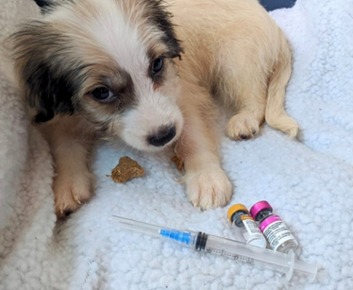
Figure 1. Gardiavax®, a vaccine used to control Giardia lamblia in dogs, Giardivax® is a first-generation vaccine that contains an inactive Giardia lamblia concentrate (≥1.2 x 10⁸ organisms/mL).
Table 1. Reports of positive cases of SARS-CoV-2 in domestic felines around the world sent to the OIE-WAHIS portal.
| Country | Positive SARS-CoV-2 cases in domestic felines |
|---|---|
| Hong Kong | 7 |
| Belgium | 1 |
| USA | 45 |
| France | 2 |
| Spain | 2 |
| Germany | 2 |
| Russia | 1 |
| United Kingdom | 1 |
| Japan | 5 |
| Italy | 1 |
| Chile | 3 |
| Canada | 10 |
| Brazil | 15 |
| Greece | 2 |
| Argentina | 4 |
| Switzerland | 3 |
| Latvia | 1 |
| Thailand | 1 |
| Total cases | 106 |
-Conclusions and Recommendations: Title must be written in lower case, bold and aligned to the left, conclusions will only be for original articles and recommendations for review articles.
-References: Use the citation and referencing style of the American Psychological Association (APA 7), latest edition. Examples:
• National Administration of Medicines, Food and Medical Technology (ANMAT). (2011). Microbiological analysis of food. Official analytical methodology. Pathogenic microorganisms. Volume 1.
https://onx.la/72aad
• Cerda, K. (2011). Evaluation of phenolic content, antioxidant activity and antidiabetic effects of agave syrup extracts (A. atrovirens Karw) [Master's Thesis, Instituto Tecnológico y de Estudios Superiores de Monterrey]. Institutional Repository of the Tecnológico de Monterrey. https://onx.la/2fcb3
• González, J., Quezada, J. & Medina, L. (2006). New perspectives for stingless beekeeping in the Yucatán: results of an integral program to rescue and promote the activity. Journal of Apicultural Research, 47(3), 234-239.
• Bruijn, L. L. M. & Sommeijer, M. J. (1997). Colony foraging in different species of stingless bees (Apidae, Meliponinae) and the regulation of individual nectar foraging. Insectes Sociaux, 44(1), 35-47. https://doi.org/10.1007/s000400050028
3. Criteria of Originality and Ethics
- Manuscripts must be original works, not previously published or under consideration for publication in another journal.
- They must strictly follow ethical principles in research, including approval by research ethics committees when applicable.
4. Shipping Process
The editorial process of the Journal of Agroecological Production Systems follows a series of well-defined steps from the submission of the article to its publication, guaranteeing the quality and relevance of the published works.
4.1 Submission of the article
Authors interested in publishing must submit their manuscripts through the electronic platform of the journal. The manuscript must comply with the editorial standards established by the journal.
4.2 Preliminary review
Once the article is received, the editor-in-chief performs a preliminary review to verify that it meets the basic requirements of the journal, such as originality, format, and thematic relevance. If the article does not meet these criteria, it is returned to the author for corrections or rejected.
4.3. Assignment of the internal committee
If the manuscript passes the preliminary review, it is assigned to the internal editorial committee, composed of experts in agroecology and related areas. The committee is in charge of carrying out the technical and scientific evaluation of the article.
4.4. Evaluation by the internal committee
The members of the editorial committee carry out a detailed review of the article, evaluating aspects such as:
Relevance of the topic in the context of agroecology.
Originality of the research.
Methodological quality, accuracy of the results and scientific rigor.
Contribution to the field of agroecological production.
Clarity and coherence in writing.
This evaluation generally takes between 2 and 4 weeks, depending on the availability of the committee and the complexity of the topic.
4.5. Editorial decision
Based on the evaluation of the internal committee, the editor-in-chief makes a decision, which may be:
Acceptance of the article without changes.
Acceptance with minor corrections, requesting the author to make style adjustments or clarifications.
Major revision, where the author is required to make substantial changes to the content and methodology.
Rejection of the article if it does not meet quality standards.
The editor communicates the decision to the author and, if necessary, details the required corrections. The author has a set period of time to make adjustments and resubmit the article.
4.6. Final revision
If the article has been accepted with corrections, the committee reviews the corrected version to verify that the requested changes have been made. In some cases, it may be necessary for the author to respond to additional comments.
4.7. Layout and proofreading
Once approved, the article goes through the layout process, where it is adjusted to the journal's publication format (typography, margins, tables, graphics). After this step, the author receives a galley proof for final review of typographical or formatting errors.
4.8. Publication
After proofreading, the article is included in the corresponding edition of the journal and is published in digital or printed format, as appropriate. The authors and members of the editorial committee receive notice of the official publication and the article is disseminated through the journal's distribution channels.
5. Declaration of Copyright and Conflict of Interest
- Authors must declare any potential conflict of interest and assign copyright to the journal, if their article is published.
These guidelines are intended to ensure that all submitted manuscripts meet the quality and ethical standards required for consideration and publication in the Agroecological Production Systems Journal. We thank the authors for choosing our magazine to disseminate their work and contribute to the advancement of agroecology and sustainability in the agricultural sector.
6. Open Access Policy
Each article published in the SPA Journal will be open access, meaning that once published, readers will be able to access the manuscripts without any subscription or membership.
Submission Preparation Checklist
All submissions must meet the following requirements.
- The submission has not been previously published, nor is it before another journal for consideration (or an explanation has been provided in Comments to the Editor).
- The submission file is in OpenOffice, Microsoft Word, or RTF document file format.
- Where available, URLs for the references have been provided.
- The text is single-spaced; uses a 12-point font; employs italics, rather than underlining (except with URL addresses); and all illustrations, figures, and tables are placed within the text at the appropriate points, rather than at the end.
- The text adheres to the stylistic and bibliographic requirements outlined in the Author Guidelines.
- .
Editorial
Política de sección por defecto
Privacy Statement
The names and email addresses entered in this journal site will be used exclusively for the stated purposes of this journal and will not be made available for any other purpose or to any other party.